
Coming soon
From Evidence to IMPACT!
Implementation Science & Research Resources
A curated collection for researchers, students, health professionals, programme implementers and policymakers.
Implementation Science & Research Resources
Ready to move evidence into real-world practice?
Whether you are new to implementation science, designing an implementation research study, selecting a framework, measuring implementation outcomes, or strengthening your skills, these resources can help.
The IMPACT Implementation Science Centre has curated a selection of practical, high-quality resources for researchers, students, health professionals, programme implementers and policymakers. Explore the collection below and find the tools you need to move from evidence to implementation - and from implementation to impact.
Learn Implementation Science
Active Implementation Hub
Learn how to implement, improve and sustain evidence-based programmes and practices.
The Active Implementation Hub provides freely accessible learning resources on implementation practice, implementation stages, drivers, teams, improvement cycles and implementation support. It is particularly useful for practitioners and teams responsible for putting programmes into practice.
Best for: Students, implementers, programme managers and implementation teams
Includes: Learning resources, practical tools and training opportunities
Explore the Active Implementation Hub
TDR Implementation Research Training Materials
Build practical skills in implementation research at your own pace.
TDR, the Special Programme for Research and Training in Tropical Diseases, provides implementation research toolkits, case studies and learning materials designed to strengthen the ability of researchers and implementers to identify implementation challenges, develop research questions and use research findings to improve programmes.
Best for: Researchers, programme implementers and learners in global health
Includes: Self-learning modules, toolkits and training resources
Explore TDR Implementation Research Training
Fogarty International Center - Implementation Science Resources
Discover implementation science learning, tools and training in one place.
The Fogarty International Center at the US National Institutes of Health provides a broad collection of implementation science resources, including training materials, implementation tools and links to additional learning opportunities.
Best for: Researchers and postgraduate students
Includes: Tools, learning resources and training opportunities
Explore Fogarty Implementation Science Resources
Global Alliance for Chronic Diseases - Implementation Science Training
Strengthen your skills in implementation research and capacity development.
The Global Alliance for Chronic Diseases supports implementation science capacity strengthening, particularly in research addressing non-communicable diseases. Its resources support researchers to strengthen implementation research skills and stakeholder engagement.
Best for: Researchers working in global health and non-communicable diseases
Includes: Implementation science training and capacity-development resources
Explore GACD Implementation Science Training
Design Your Implementation Research
Dissemination & Implementation Models in Health Webtool
Not sure which implementation framework to use? Start here.
This interactive tool helps researchers and practitioners identify theories, models and frameworks that fit their research question or implementation problem. It can also support development of logic models, selection of measures, combining frameworks and adapting frameworks to different contexts.
Best for: Selecting and applying implementation theories, models and frameworks
Explore the D&I Models Webtool
Implementation Science Research Development (ImpRes) Tool
Turn an implementation problem into a well-designed research study.
The ImpRes Tool provides a structured approach to designing implementation research. It guides researchers through key decisions including framework selection, contextual determinants, implementation strategies, outcomes, stakeholder involvement and evaluation.
Best for: Developing protocols, research proposals and implementation studies
Download the ImpRes Practical Guide
Implementation Research in Health: A Practical Guide
A practical introduction to implementation research for real-world health systems.
Developed by the World Health Organization and the Alliance for Health Policy and Systems Research, this guide introduces the foundations of implementation research and shows how research can be used to understand and address implementation problems in health programmes and systems. It is particularly relevant to implementation research in low- and middle-income countries.
Best for: Anyone beginning implementation research or working on health-system implementation challenges
Access the WHO Practical Guide
Choose and Apply Implementation Frameworks
Consolidated Framework for Implementation Research (CFIR)
Understand what helps - and what gets in the way of implementation.
CFIR provides a comprehensive framework for systematically examining factors that influence implementation. It can help researchers and implementers identify barriers and facilitators, understand context and inform the selection or adaptation of implementation strategies.
Best for: Assessing implementation determinants and context
Exploration, Preparation, Implementation, Sustainment (EPIS) Framework
Follow implementation from exploration to long-term sustainment.
EPIS helps researchers and implementers examine implementation across four phases: Exploration, Preparation, Implementation and Sustainment. It considers factors within organisations, the wider system, the intervention itself and the relationships that connect different parts of the implementation environment.
Best for: Studying implementation processes over time
Centre for Effective Services Guide to Implementation
Make implementation concepts easier to understand and apply.
This accessible online guide introduces key implementation concepts, terminology and approaches. It is designed for researchers as well as policymakers, practitioners, organisations and teams responsible for introducing or managing change.
Best for: Practical introductions to implementation concepts and implementation planning
Explore the CES Guide to Implementation
Measure Implementation Outcomes
Implementation Outcome Repository
Find the right measure for the implementation outcome you want to study.
The Implementation Outcome Repository is a free online collection of quantitative instruments for measuring implementation outcomes. It can help researchers and practitioners identify suitable measures when evaluating how well an intervention, programme or service is being implemented.
Best for: Selecting implementation outcome measures and developing study tools
Explore the Implementation Outcome Repository
Where Should I Start?
- New to implementation science? Start with the WHO Practical Guide, TDR Implementation Research materials or the Active Implementation Hub.
- Designing a study or proposal? Try the ImpRes Tool and the D&I Models Webtool.
- Choosing a framework? Explore CFIR, EPIS and the D&I Models Webtool.
- Developing questionnaires or outcome measures? Visit the Implementation Outcome Repository.
- Looking for training? Explore the Active Implementation Hub, TDR, Fogarty International Center and GACD.
Keep Learning. Keep Implementing. Keep Improving.
Implementation science is about more than knowing what works. It helps us understand how, why, where and for whom interventions work - and how successful approaches can be adapted, scaled and sustained in real-world settings.
Explore these resources and strengthen your capacity to turn evidence into impact.
IMPLEMENTATION RESEARCH RESOURCES
Active Implementation Hub:
https://implementation.fpg.unc.edu/.
The Active Implementation Hub is a free, online learning environment for use by any interested party involved in the active implementation and scaling up of programs and innovations. The site goal is to increase the knowledge and improve the performance of persons engaged in actively implementing any program or practice. This site includes training opportunities.
Dissemination & Implementation Models in Health:
https://dissemination-implementation.org/tool/.
This interactive webtool is designed to help researchers and practitioners develop a ‘logic model’ or diagram for their research or practice question, select the dissemination and implementation (D&I) theories, models, and frameworks (TMFs) that best fit(s) their research question or practice problem, combine multiple D&I TMFs, adapt the D&I TMF(s) to the study or practice context, use the D&I TMF(s) throughout the research or practice process, and find existing assessments to measure the key constructs of the D&I TMF(s) selected.
Fogarty International Centre, Resources for Implementation Science Researchers: https://www.fic.nih.gov/About/center-global-health-studies/neuroscience-implementation-toolkit/Pages/resources.aspx.
A wide-ranging collection of implementation science resources curated by the Fogorty International Centre. This site includes links to training opportunities.
Global Alliance for Chronic Diseases, Implementation Science Training:
https://www.gacd.org/research/capacity-development.
GACD support research capacity strengthening in implementation science focusing on non-communicable diseases. They offer live training events, self-guided programmes via their Implementation Science e-Hub, and other activities to increase the skills, knowledge, and confidence of individuals to conduct high-quality implementation research and engage with all relevant stakeholders. This site includes training opportunities.
Implementation Outcome Repository:
https://implementationoutcomerepository.org/.
Improving the implementation of evidenced-based healthcare interventions and services through implementation outcome measurement. A free online resource for implementation stakeholders, including researchers and healthcare professionals, wishing to quantitatively measure implementation outcomes.
TDR: the Special Programme for Research and Training in Tropical Diseases, Implementation Research Training Materials:
TDR offer a wide range of materials on implementation research, including resource toolkits and online training courses. This site includes training opportunities.
Consolidated Framework for Implementation Research (CFIR):
The CFIR provides a menu of constructs arranged across 5 domains that can be used in a range of applications. It is a practical framework to help guide systematic assessment of potential barriers and facilitators. Knowing this information can help guide tailoring of implementation strategies and needed adaptations, and/or to explain outcomes.
Exploration, Preparation, Implementation, Sustainment (EPIS) Implementation Framework:
The EPIS Framework highlights key phases that guide and describe the implementation process and enumerates common and unique factors within and across levels of outer context (system) and inner (organizational) context across phases, factors that bridge outer and inner context, and the nature of the innovation or practice being implemented and the role of innovation/practice developers.
Centre for Effective Services (CES) Guide to Implementation Frameworks
https://implementation.effectiveservices.org/.
This online guide introduces the key terms, concepts and frameworks associated with implementation. Its primary purpose is to support any person, team or organisation introducing or seeking to change – whether they are policymakers, service providers, practitioners or researchers.
Implementation Science Research Development (ImpRes) Tool: A Practical Guide to Using the ImpRes Tool
https://impsci.tracs.unc.edu/wp-content/uploads/ImpRes-Guide.pdf.
This guide provides a systematic step-by-step approach to designing implementation research and is intended to be used in conjunction with the ImpRes tool.
Implementation Research and Health: A Practical Guide:
https://iris.who.int/bitstream/handle/10665/91758/9789241506212_eng.pdf.
Intended to support those conducting implementation research, those with responsibility for implementing programmes, and those who have an interest in both, the Guide provides an introduction to basic implementation research concepts and language, briefly outlines what it involves, and describes the many opportunities that it presents. The main aim of the Guide is to boost implementation research capacity as well as demand for implementation research that is aligned with need, and that is of particular relevance to health systems in low- and middle-income countries (LMICs).
ANITA BHEBHE
My research title is "Investigation of Digital Health Interventions for HIV Pre-Exposure Prophylaxis Engagement among At-Risk Adolescent Girls and Young Women in Lusaka, Zambia"
Overview: This study investigates digital health interventions (DHIs) for HIV pre-exposure prophylaxis (PrEP) among at-risk adolescent girls and young women (AGYW) in Lusaka, Zambia, a population disproportionately vulnerable to HIV despite PrEP's proven efficacy. Using a multi-phase, mixed-methods design across three settings (community, higher learning institution, and health facility) the study combines a quantitative survey, focus group discussions, and key informant interviews to examine PrEP awareness and uptake, the barriers and facilitators to DHI engagement, and the implementation and perceived effectiveness of a mobile application supporting PrEP service delivery.
The study is anchored by an integrated conceptual framework combining the Consolidated Framework for Implementation Research (CFIR) with the Social-Ecological Model and a Digital Health Access and Adoption Lens, allowing it to bridge behavioural and implementation science perspectives. Findings are expected to generate contextual evidence to inform the design and scale-up of DHIs that meaningfully reach and support at-risk AGYW in Lusaka and similar low-resource setting
PhD Research Profile
Dr. Emmanuel Mung’omba
Research Title
Development and Evaluation of a Diagnostic-Informed Antimicrobial Stewardship Model for Optimizing Empirical Antibiotic Treatment and In-Hospital Outcomes among Patients with Advanced HIV Disease at Ndola Teaching Hospital, Zambia
Brief Research Write-Up
My PhD research focuses on developing and evaluating a diagnostic-informed antimicrobial stewardship model for hospitalized patients with advanced HIV disease at Ndola Teaching Hospital, Zambia. The study examines how empirical antibiotic prescribing, blood-culture utilization, antimicrobial susceptibility testing and treatment modification influence in-hospital outcomes.
Using an explanatory sequential mixed-methods design, the research will combine prospective patient-level clinical, microbiological, prescribing and outcome data with interviews involving clinicians, laboratory personnel and antimicrobial stewardship stakeholders. The Consolidated Framework for Implementation Research will guide the identification of multilevel barriers and facilitators affecting diagnostic utilization, clinician-laboratory communication and the transition from empirical to laboratory-guided antibiotic treatment.
The proposed model will also be evaluated using Proctor’s Implementation Outcomes Framework, with particular focus on its acceptability, appropriateness and feasibility among intended users. These outcomes will be assessed using the Acceptability of Intervention Measure, Intervention Appropriateness Measure and Feasibility of Intervention Measure.
The study is expected to produce a context-specific model that strengthens diagnostic stewardship, improves antibiotic decision-making and supports better in-hospital outcomes for patients with advanced HIV disease.
Reimagining researchers as evidence entrepreneurs: a qualitative case study following a cluster randomized trial of person-centered care in Africa.
By Sandra Simbeza.
Background
Research evidence often reaches policy and practice slowly and inconsitently, even when findings are robust and stakeholders agree, that, they can improve health if used. This gap in uptake is one of the motivating dilemmas in implementation science. Established frameworks about evidence translation (e.g., Kingdon, Weiss) explain why evidence stalls, waiting for convergence with the right political climate but rarely examine the role of the research teams themselves as an active agent in translation. More recently there has been calls for researchers to be actively engaged in evidence traanslation processes and their work to have impact. We analyse the role of a reaserch team based at an Non-Govermental Organisation in Zambia to promote results from a cluster randomised trial.
Methods
Initial trial: A stepped-wedge, cluster-randomized trial (PCPH) tested a three-part person-centered care (PCC) intervention, that include provider trainings and mentorship in PCC, provision of client experience feedback, and gentle facility incentives across 24 public helath facilities in Zambia (2019–2021). The trial showed that the PCC intervention led to improved client experience with a reduction of individuals with negative client experiences from 23.3% in the control group to 3.5%≥ 6 months of exposure to the intervention, decreased missed visits from 25.3% during control periods to 22.6% in the first 6 months of the intervention and improved 15-month overall retention of 5.9% and an increase of 12.7% among New ART initiate.The trial found no effect on viral load suppression in a subset of individuals.(DOI: 10.1016/S2352-3018(24)00264-9).
Post-trial engagement: Throughout the evidence entrepreneurship process, the research team undertook a three part process to promote intergration of PCC evidence into Zambia health system. The first part involved stakeholder engagment, then systematic documentation of the process to capture interactions, decisions and lessons learned.The last process involved review of national policy and program documents to understand where, and to what extent, findings from the trial had been reflected or intergrated into policy and practice.
Findings
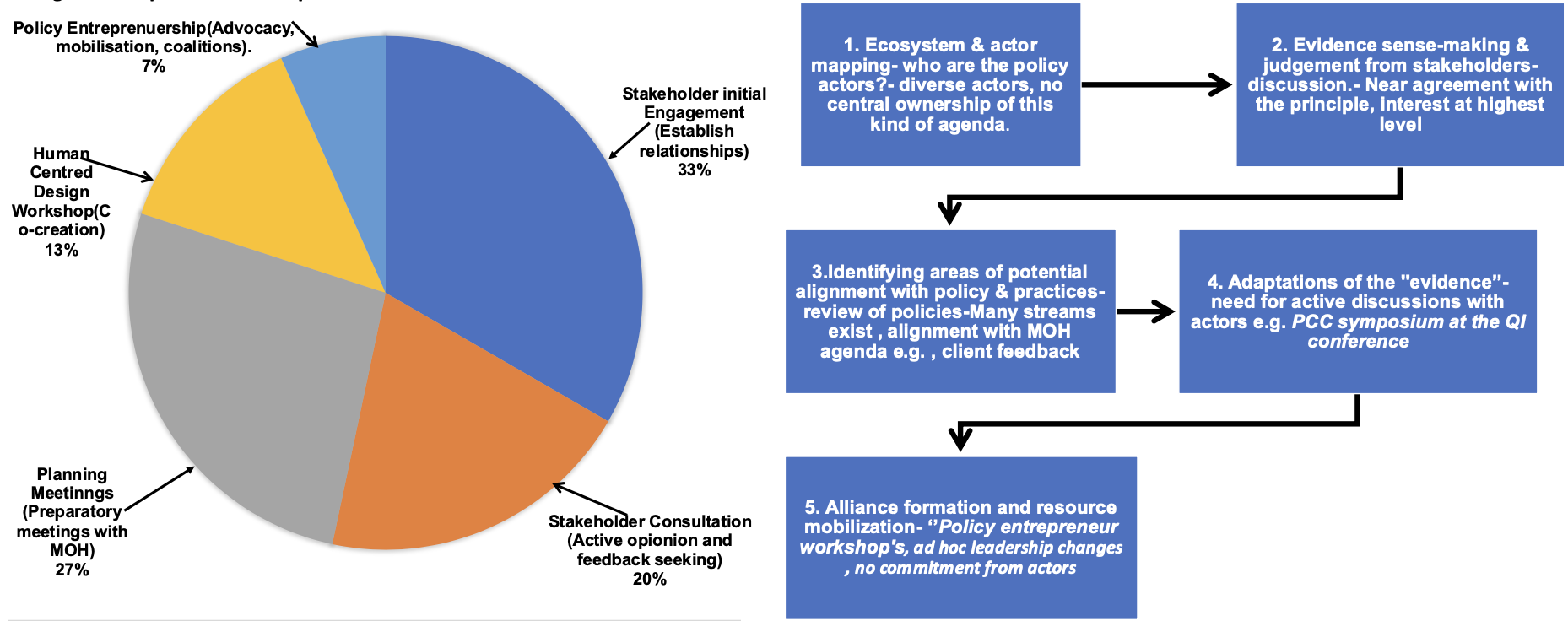
Our findings show that researchers from a Non-Governmental Organisation with evidence from a cluster randomised trial that greater patient-centred communications can improve retention in HIV care followed “a five-step evidence entrepreneurship journey”(figure 1), to support research evidence uptake. This process is not linear, and research evidence is re-authored according to the mandates and institutional priorities and interests of stakeholders.
Implications for Policy and Impact
The findings contribute to research evidence uptake and utilisation literature, by demonstrating how researchers can navigate complex, multi actor health systems, as active agents to promote the uptake of research evidence, extending their role beyond research evidence generation. The study also shows that the strength of the evidence alone is not adequate to ensure uptake. Our study proposes a five-step process(see below) that can be replicated by researchers in other settings to facilitate evidence translation into routine practice and policy.
Note:
This work resulted into a manuscript that is currently under review for publication.
Figure 1: Five-step evidence entrepreneurship journey
RESEARCH STUDIES
MEASLES-CONTAINING VACCINE (MCV) PRESENTATION SWITCHES IN ZAMBIA- IMPACT, EXPERIENCES, COST-EFFECTIVENESS AND LESSONS LEARNED. (2025-2026)
- This project examined how Zambia’s switch from 10-dose to 5-dose measles-containing vaccine vials was adopted, experienced, and operationalized within routine immunization systems. Using mixed methods, the study explored implementation outcomes such as acceptability, feasibility, service responsiveness, wastage, cost, equity, and health worker decision-making. Findings showed that the switch improved flexibility in service delivery, reduced missed vaccination opportunities, and strengthened willingness to vaccinate small numbers of children, while also highlighting the need for stronger communication, supervision, data systems, and rural outreach to support effective and equitable scale-up.
COORDINATED BY: MEASLES CONTAINING VACCINE SWITCH IMPACT CONSORTIUM (MSIC)
ZAMBIA STUDY LEADS:
- Dr Mumbi Chola, Center for Infectious Disease Research In Zambia (CIDRZ)
- Dr Musaku Mwene Chanya, University Teaching Hospital
- Prof Hikabasa Halwiindi, University of Zambia, IMPACT.
2. Addressing Implementation Challenges to Reach Under-Vaccinated and Zero-Dose Children in Zambia (2025-2026)
This implementation research project examined how the Reaching Every District/Reaching Every Community (RED/REC) strategy is being implemented in Zambia and identified practical solutions to improve routine immunisation coverage, particularly among zero-dose and under-immunised children. Using a mixed-methods design across six high-burden districts, the study assessed implementation fidelity, identified determinants of zero-dose status, explored context-specific implementation mechanisms, and documented local adaptations that enable health workers to reach underserved populations.
SUPPORTED BY UNICEF
Investigators:
- Prof Choolwe Jacobs
- Prof Hikabasa Halwiindi
- Dr Margaret Munakaampe
- Dr Nachizya Namukanga
- Dr Patrick Kaonga
- Ms Mwiche Musukuma-Thole
3. AHEAD: addressing Health Knowledge gaps in Zambia in zones of environmental harm and chronic disease (2026-2029)
The AHEAD (Addressing Health Knowledge Gaps in Zambia in Zones of Environmental Harm and Chronic Disease) project, co-led by James Wintrup and Dr. Hikabasa Halwiindi, focuses on bridging critical health knowledge gaps in Zambian communities affected by environmental hazards and chronic diseases. By engaging communities directly, the project aims to enhance health literacy, inform policy, and empower populations to advocate for healthier environments. Through interdisciplinary collaboration and stakeholder engagement, AHEAD strives to promote equitable health outcomes and strengthen health systems' capacity to respond to environmental health challenges.
SUPPORTED BY RESEARCH COUNCIL OF NORWAY
Investigators:
- Dr James Winstrup - PI
- Prof Halwiindi - PI
- Dr Chisel mEKI - Investigator